Answer important calls without turning service into a phone maze.
A well-designed AI receptionist can handle defined conversations, capture structured details and move the caller to the next useful step. It should also be transparent, easy to escape and quick to hand off.
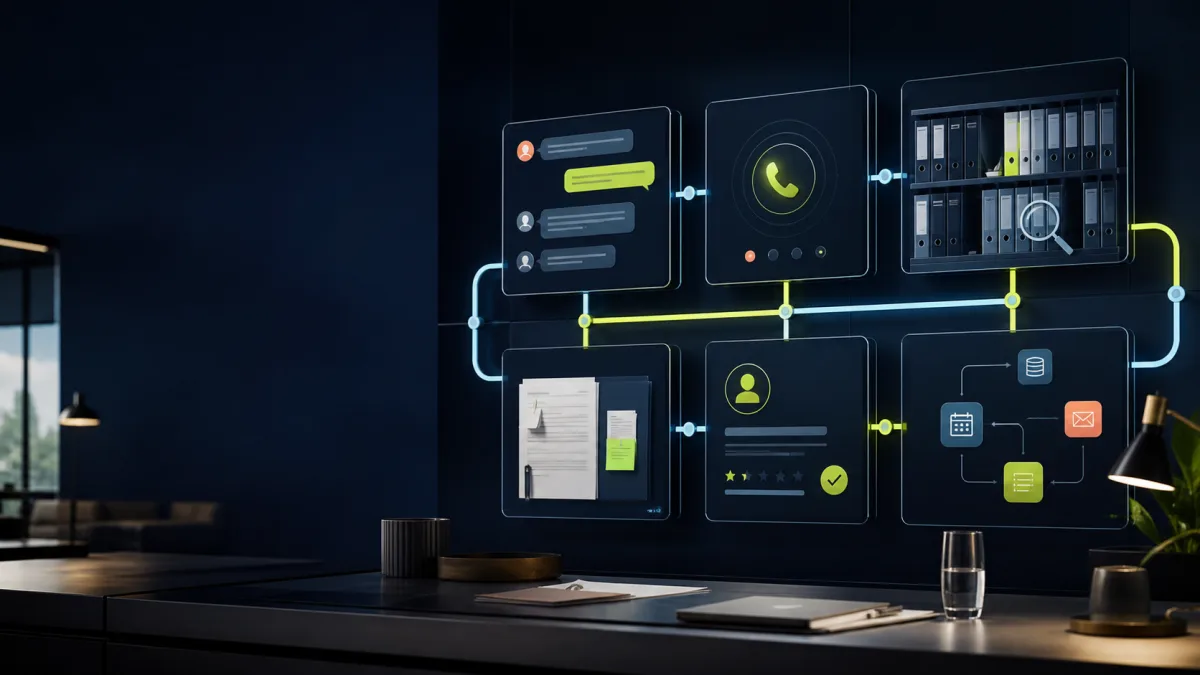
Where the friction usually appears.
A voice workflow designed around completed outcomes - a booking, a qualified enquiry, a useful message or a clean transfer - rather than a demo that merely sounds human.
Missed calls
Enquiries arrive while staff are busy, travelling or outside opening hours.
Repeated interruptions
Routine questions break concentration throughout the working day.
Unstructured messages
Names, needs and next actions get lost in voicemail or incomplete notes.
A complete workflow, not an isolated feature.
The exact scope follows your process, systems, data and risk. These are common building blocks, not a claim that every business needs all four.
Inbound call handling
Welcome callers, explain that they are speaking with an AI assistant and identify their reason for calling.
Qualification and routing
Capture agreed details, apply deterministic routing rules and transfer priority calls to a person.
Appointment workflows
Check permitted availability, create or request bookings and send a clear confirmation.
Call summaries
Write structured notes to the CRM or inbox so staff can act without replaying the full conversation.
How the implementation works.
Choose one high-volume call type
Write approved answers and hard escalation rules
Connect telephony, calendar and CRM in a test environment
Run test calls before a monitored pilot
Pilot blueprint: prove the completed loop
The first pilot should measure answer rate, caller completion, correct routing, booking accuracy, transfers and opt-outs. We do not publish a missed-call or conversion claim until your own call data proves it.
Useful automation needs boundaries.
We design for privacy, access control, human ownership and recoverable failure from the beginning. Security and compliance requirements are scoped to the actual data and decisions involved.
- Approved sources and least-privilege access
- Human approval for high-impact actions
- Clear refusals, escalation and opt-out routes
- Test cases for normal and adverse conditions
- Run logs, alerts, retries and rollback
- Ongoing review after the workflow changes
What decision-makers usually ask.
Will callers know it is AI?+
Yes. The experience should identify itself clearly and make the human handoff easy. Deception is not a conversion strategy.
Can it book directly into our calendar?+
It can where the calendar, availability rules and permissions support a safe integration. Complex or ambiguous requests can be routed for confirmation instead.
Can it handle outbound sales calls?+
We prioritise inbound and consented workflows. Automated outbound calling carries stricter legal and reputational risk and is not launched without a separate compliance review.
Bring us the bottleneck. We will map the safest useful next step.
Tell us what repeats, where it gets stuck and which systems are involved. We will reply within four UK working hours with the questions needed to scope a practical pilot.

Recent Comments