Connect the steps between your tools, not just another isolated AI feature.
The highest-value automation is often the work between systems: receiving a request, checking context, drafting an action, asking for approval, updating the record and confirming what happened.
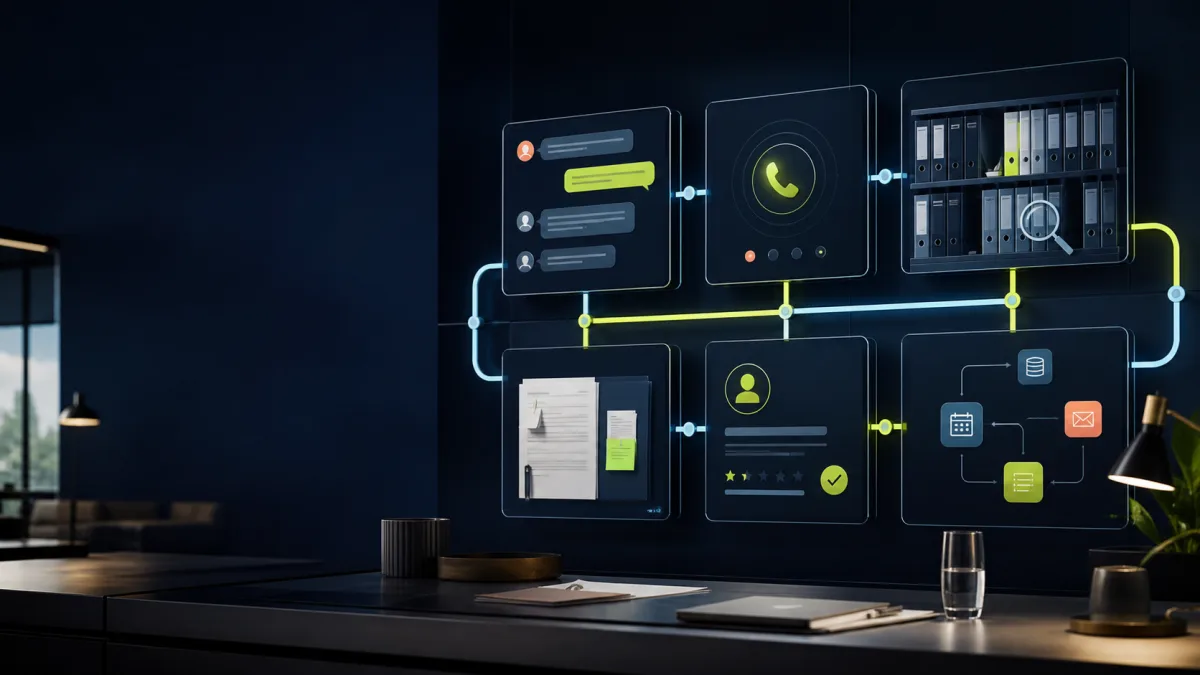
Where the friction usually appears.
A documented workflow with clear triggers, permissions, human decisions, failure handling, monitoring and rollback.
Copy-and-paste operations
Teams move the same information between inboxes, forms, spreadsheets and CRMs.
Invisible failures
A brittle automation stops quietly and nobody knows which customer or record was missed.
Automation sprawl
Disconnected tools create more dashboards and maintenance instead of less work.
A complete workflow, not an isolated feature.
The exact scope follows your process, systems, data and risk. These are common building blocks, not a claim that every business needs all four.
Workflow discovery
Map the actual process, exceptions and owners before choosing technology.
System integration
Connect APIs, webhooks, email, calendars, databases and approved low-code platforms.
Human approval gates
Pause before financial, legal, customer-facing or destructive actions that need judgement.
Operations visibility
Record runs, errors, approvals and recovery actions in one useful control surface.
How the implementation works.
Observe the current process and baseline
Remove unnecessary steps before automating
Build one end-to-end path with failure handling
Monitor production and expand only after evidence
Verified example: one command centre for nine websites
Our own operations layer combines site health, scheduled tasks, content queues, social work, SEO status and security evidence across nine hosted websites. It is deliberately read-only where visibility is needed but production authority is not.
Useful automation needs boundaries.
We design for privacy, access control, human ownership and recoverable failure from the beginning. Security and compliance requirements are scoped to the actual data and decisions involved.
- Approved sources and least-privilege access
- Human approval for high-impact actions
- Clear refusals, escalation and opt-out routes
- Test cases for normal and adverse conditions
- Run logs, alerts, retries and rollback
- Ongoing review after the workflow changes
What decision-makers usually ask.
Which process should we automate first?+
Choose a frequent, measurable process with stable inputs, clear ownership and enough manual friction to justify the work. Avoid starting with the most politically complex process.
Do you only use one automation platform?+
No. The architecture should follow the systems, permissions and support needs. We use deterministic scripts, APIs and appropriate workflow tools rather than forcing every job into one platform.
What happens when an integration fails?+
Production workflows need retries, idempotency, clear error states, alerts and a recovery route. Silent failure is treated as a design defect.
Bring us the bottleneck. We will map the safest useful next step.
Tell us what repeats, where it gets stuck and which systems are involved. We will reply within four UK working hours with the questions needed to scope a practical pilot.

Recent Comments